Contents13 sections
This guide was first published in German on handgetestet.de.
At night the neighbor’s heat pump hums, and the smartphone app shows 43 dB. What is that number worth? As a pointer for yourself, quite a bit; as evidence, next to nothing. For orientation, we consider the ELV ST 8820 the sensible buy; if you want to record a profile over several hours, go for the class 2 Trotec SL400. Neither of them has evidentiary value in the sense of the TA Lärm, Germany’s Technical Instructions on Noise Protection.
What is behind dB(A)?
The decibel is a logarithmic unit. People perceive ten decibels more as roughly twice as loud, which is why 50 and 60 dB are two different worlds in everyday life. The A in parentheses stands for a filter. It mimics human hearing and, according to the ELV manual, mainly weights the range from about 500 to 10,000 hertz. Curve C is considerably flatter. Testo points out that it lets you assess the low-frequency components of a noise. If a sound is dull and the meter shows much more on C than on A, you already know something about its nature.
Then there is time weighting. Fast averages over 125 milliseconds, Slow over one second. The TA Lärm generally works with A and Fast. Even so, the reading on the display is not the value that matters in a dispute. What counts is the rating level: an average over the assessment period, plus surcharges, for example for tonal or impulsive noise. A snapshot of 43 dB says little about that.
Class 1, class 2 and everything below
The standard DIN EN 61672-1 sets error limits for sound level meters, separately for class 1 and class 2. Class 1 is the stricter one. Trotec and Testo state ±1.4 dB for their class 2 devices. Simple handheld meters often do not state a class at all. For the ST 8820, ELV specifies ±3.5 dB, based on a 1 kHz sine tone at 94 dB, in other words under favorable conditions. With a quiet, low hum, the deviation can turn out differently. Even a class label does not cover all frequencies equally. The Institute for Occupational Safety and Health of the DGUV (German Social Accident Insurance) points to large permitted deviations above 10 kHz.
Why do smartphone apps and hardware-store meters count for so little?
Because the rules require something else. The annex to the TA Lärm permits verified (legally calibrated) class 1 sound level meters for measurements. Unverified equipment is only allowed in justified individual cases, and then the deviations must be quantified in a traceable way. German legal metrology law also covers sound pressure level as soon as devices are used in commercial or official transactions. For private use, you may measure with whatever you like. That does not turn it into proof.
Let us work through the heat pump example. Air source heat pumps are subject to the TA Lärm, as the State Institute for the Environment in Baden-Württemberg (LUBW) notes. In general residential areas, the night limit is 40 dB(A), in purely residential areas 35 dB(A), measured 0.5 meters in front of the center of the open window of the most affected room. If a device with ±3.5 dB shows 42 dB there, the true level can be 38.5 or 45.5 dB. Below or above the guideline value? There is no way to tell. And even the authorities subtract 3 dB(A) in monitoring measurements before they compare.
With apps, the microphone comes into play as well. The US occupational safety institute NIOSH offers its own measuring app for iPhone and iPad only. According to NIOSH, it meets the requirements for type 2 with a calibrated external microphone. According to the institute, Android devices currently cannot be reliably checked at all because of the many different microphones. So you should not trust the level from a free, uncalibrated app any more than a rough estimate.
Does the TA Lärm even apply to my case?
Often not. It applies to installations, such as businesses or building services equipment. It explicitly excludes sports facilities and many leisure facilities. Parties, TVs and DIY work fall under neighborhood noise, and according to the German Environment Agency (Umweltbundesamt), that is covered by the immission control laws of the German states, municipal rules and house rules. Whether a disturbance is significant is ultimately decided by the court. Under § 906 of the German Civil Code (BGB), an insignificant impairment generally exists if guideline values are complied with; that does not give you a fixed decibel value for every dispute.
Outdoor equipment has its own time rules. The German 32nd Federal Immission Control Ordinance (32. BImSchV) prohibits operating many machines in residential areas on Sundays, public holidays and on weekdays from 8 p.m. to 7 a.m. For leaf blowers (in German), brush cutters and lawn edge trimmers, additional restricted hours apply unless they carry an eco-label. Here a clock is all you need; nothing has to be measured.
The noise log matters more than the device
In our view, a list covering several weeks carries more weight than a single number. For each incident, write down the date, start and end, type of noise, the room in which you hear it, the effect (woken up, conversation impossible) and who else noticed it besides you. The measured value goes in as the last column, always with the device, weighting and location.
As for the measurement itself: fit the windscreen, hold the device steady and level, microphone toward the source. Note extraneous noise such as traffic or rain in the same row. Also follow the order recommended by the German Environment Agency: first talk to the person causing the noise, then the landlord or property management, after that the public order authority. If the dispute persists, the German consumer advice center (Verbraucherzentrale) can help with its book „Meine Rechte als Nachbar“ („My rights as a neighbor“), which covers quiet hours and mediation. Your notes cannot replace a report from an acoustics consultancy, but they show when a measurement is needed.
Five devices for five needs
| Model | Class according to manufacturer | Range, accuracy | Recording | Best for |
|---|---|---|---|---|
| ELV ST 8820 | none stated | 35–130 dB, ±3.5 dB | no (Hold, Max) | Orientation, plus light and climate |
| Trotec SL400 | Class 2 (IEC 61672) | 30–130 dB, ±1.4 dB | up to 32,700 values, USB | Profile over several hours |
| testo 816-1 | Class 2 (IEC 61672-1) | 30–130 dB, ±1.4 dB | up to 31,000 values, software | Businesses, property management |
| Extech 407732 | Type 2 (IEC 651) | 35–130 dB, ±1.5 dB | no memory stated | Spot checks with a stated class |
| Trotec BS06 | none stated | 40–130 dB(A), ±3.5 dB | no (Min, Max) | Band rehearsal, workshop |
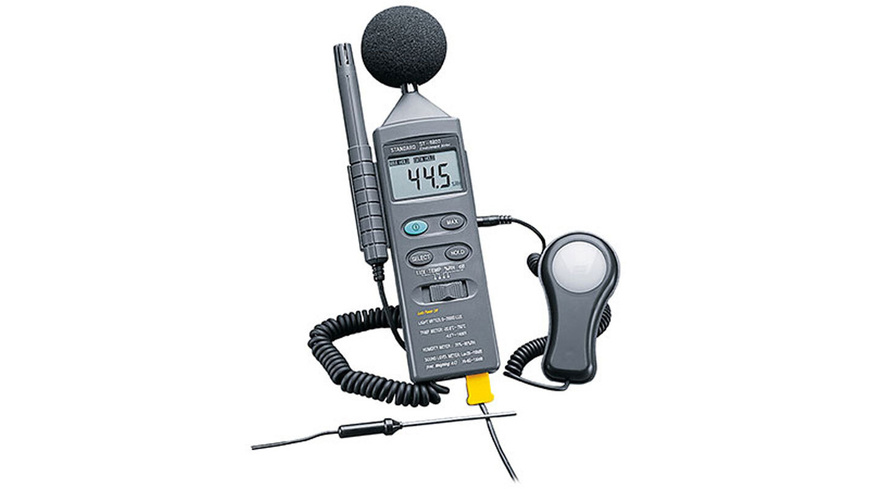
ELV ST 8820
A combination device for sound, light, humidity and temperature. According to ELV, the sound measurement goes down to 35 dB and offers curves A and C, Hold and Max. That is enough to answer whether you have a problem at all. The lower limit is useful for nighttime readings; the Trotec BS06 already stops at 40 dB. There are plenty of compromises: only Fast time weighting, no recording, no class. It measures humidity with ±5 percent. For walls, that does not replace a moisture meter, and carbon dioxide is only captured by a CO2 meter (in German).
Trotec SL400
Here you get class 2, both time weightings, a tripod thread and memory for up to 32,700 values. According to Trotec, software and a calibration certificate are included. That turns a night into a chart, which gets you further in a conversation with your landlord than a single reading. The certificate is not a legal verification, though. The device operates between 0 and 40 degrees Celsius, which is not enough for a winter evening on the balcony.
testo 816-1
Technically close to the SL400, plus 99 individual readings and 31,000 values in measurement series. According to Testo, it can be recalibrated on site with an optional sound calibrator. That makes a case for businesses that measure regularly. For private use, it is more device than a neighborhood dispute calls for.
Extech 407732
Two measuring ranges, ±1.5 dB, type 2 according to the older IEC 651. More accurate for spot checks than the simple devices. Extech does not mention any memory, so you write the values down by hand.
Trotec BS06
The simplest device here: dB(A) only, from 40 dB, ±3.5 dB, minimum and maximum, windscreen in the box. That is enough for a rehearsal room or workshop, while quiet nights sit at the lower edge of its range. If you work on loud machines, you should put the money into good hearing protection first.
How we would decide
- You want to know whether a noise stands out at night: ELV ST 8820.
- You need a profile for your landlord or property management: Trotec SL400.
- You measure professionally and want to recalibrate: testo 816-1.
- Checking volume in a rehearsal room or at a machine: Trotec BS06.
- It is about a lawsuit or the authorities: no purchase, but the public order office or an acoustics consultancy with verified class 1 equipment.
How to tame the bass in a rented apartment is covered in the guide to the soundbar with subwoofer (in German). If you are looking for a bigger speaker for your next garden party, you will find it in the guide Black Friday party speakers (in German).
Frequently asked questions
What does dB(A) mean?
The decibel is a logarithmic unit; people perceive ten decibels more as roughly twice as loud. The A stands for a filter that mimics human hearing and, according to the ELV manual, mainly weights the range from about 500 to 10,000 hertz. Curve C lets you assess low-frequency components.
What is the difference between class 1 and class 2?
The standard DIN EN 61672-1 sets error limits for both classes, with class 1 being the stricter one. Trotec and Testo state ±1.4 dB for their class 2 devices. Simple handheld meters often do not state a class at all; for the ST 8820, ELV specifies ±3.5 dB.
Is a smartphone app good enough for measuring noise?
Only as a rough estimate. According to NIOSH, the app from the US institute for iPhone and iPad only meets the requirements for type 2 with a calibrated external microphone. Android devices currently cannot be reliably checked because of the many different microphones.
Does your own noise measurement count as evidence?
Hardly. The annex to the German TA Lärm permits verified (legally calibrated) class 1 sound level meters; unverified equipment only in justified individual cases. If a device with ±3.5 dB shows 42 dB, the true level can be 38.5 or 45.5 dB. For a lawsuit or the authorities, the local public order office or an acoustics consultancy is the right point of contact.
Does the TA Lärm also apply to noise from neighbors?
Often not. It applies to installations such as businesses or building services equipment, for example air source heat pumps. According to the German Environment Agency, parties, TVs and DIY work fall under neighborhood noise, which is governed by state laws, municipal rules and house rules. Whether a disturbance is significant is ultimately decided by the court.
How do I keep a noise log?
For each incident, write down the date, start and end, type of noise, the room, the effect and who else noticed it besides you. The measured value goes in as the last column, always with the device, weighting and location. A list covering several weeks carries more weight than a single number.
Sources
- TA Lärm: Sixth General Administrative Regulation under the German Federal Immission Control Act (BImSchG)
- TA Lärm, annex: Determination of noise immissions
- German Environment Agency (Umweltbundesamt): Neighborhood noise
- LUBW Baden-Württemberg: Neighborhood noise
- Verbraucherzentrale: Meine Rechte als Nachbar (My rights as a neighbor)
- § 906 German Civil Code (BGB)
- 32nd BImSchV (German equipment and machinery noise ordinance), § 7
- German Measurement and Verification Ordinance (MessEV), § 1
- IFA of the DGUV: Measuring and assessing ultrasonic noise (PDF)
- NIOSH: Sound Level Meter App
- Wikipedia (German): Loudness
- ELV: 4-in-1 environmental meter ST 8820 (retailer information)
- ELV: ST 8820 user manual (PDF)
- Trotec: SL400 sound level meter
- Trotec: SL400 operating manual (PDF)
- Trotec: BS06 sound level meter
- Testo: testo 816-1 data sheet (PDF)
- Extech: 407732 Sound Level Meter
Where to buy
- ELV ST 8820View at ELVAvailable in Germany: ELV
- Trotec SL400Check price at Amazon.deCheck price at Amazon.co.ukCheck price at Amazon.nlCheck price at Amazon.com.beCheck price at Amazon.frCheck price at Amazon.itCheck price at Amazon.esCheck price at Amazon.plCheck price at Amazon.seAvailable in Germany: Amazon.de
- testo 816-1Check price at Amazon.deCheck price at Amazon.co.ukCheck price at Amazon.nlCheck price at Amazon.com.beCheck price at Amazon.frCheck price at Amazon.itCheck price at Amazon.esCheck price at Amazon.plCheck price at Amazon.seAvailable in Germany: Amazon.de
- Extech 407732Check price at Amazon.deCheck price at Amazon.co.ukCheck price at Amazon.nlCheck price at Amazon.com.beCheck price at Amazon.frCheck price at Amazon.itCheck price at Amazon.esCheck price at Amazon.plCheck price at Amazon.seAvailable in Germany: Amazon.de
- Trotec BS06Check price at Amazon.deCheck price at Amazon.co.ukCheck price at Amazon.nlCheck price at Amazon.com.beCheck price at Amazon.frCheck price at Amazon.itCheck price at Amazon.esCheck price at Amazon.plCheck price at Amazon.seAvailable in Germany: Amazon.de