Contents14 sections
This guide was first published in German on handgetestet.de.
At first glance at a wood lathe’s data sheet, the eye gets caught on the distance between centers. A meter sounds like freedom. Typical first projects, however, are short: a tool handle, a box, a small bowl from a piece of fruitwood. For those, other values count, namely a low minimum speed, a heavy bed and a spindle thread that fits common chucks. For a serious start, we therefore consider a cast iron machine such as the Holzmann D510F the sensible choice. If you first want to turn handles and candlesticks, the smaller Holzmann D460FXL will do. And for model making, there is a machine that has nothing in common with either.
Distance between centers and center height: what the two dimensions tell you
The distance between centers is the space between the drive center in the headstock and the center point in the tailstock. It limits the length of a workpiece running between the two centers. Table legs, stair balusters and rolling pins fall into this category. Around 460 to 510 mm is enough for handles, candlesticks and short spindles. Chair legs need more. Holzmann offers bed extensions for the D460FXL and the D510F, and Record Power does the same for the DML320.
More important for bowls is the center height. It is measured from the bed to the center of the spindle and therefore corresponds to the radius. With a center height of 160 mm, a disc of at most 32 cm in diameter turns over the bed. The specifications are not uniform. Scheppach and Record Power state the swing over the bed directly, Holzmann and Proxxon only the center height. Double it once, and the comparison works.
Why the slowest speed matters more than the fastest
A fresh bowl blank is never round. Bark, cracks and unevenly distributed wood create an imbalance that makes a light machine walk across the workbench at high speed. In the manual for the D460FXL, Holzmann says to work large and unbalanced workpieces only at a low spindle speed and to go faster only once the piece runs evenly round. That is exactly why a machine needs reserves at the low end.
This is where the machines clearly part ways. According to the manufacturers, the D510F and the Record Power DML320 start at 250 revolutions per minute, the D460FXL at 650 and the two Scheppach machines at 800. If you want to turn large blanks, read the lower limit first. At the top end, all six machines have enough headroom for thin spindles.
The type of speed adjustment also makes a difference in everyday use. On the Scheppach DM1100T, the belt is moved to one of four steps. On the D460FXL, Holzmann combines three belt ranges with variable control and a digital display. The D510F works with a frequency inverter which, according to the manufacturer, delivers high torque even at low speeds, and it can run in both directions. You will appreciate reverse when sanding.
Thread, taper, weight: the invisible accessories
The machine is only half the purchase. Sooner or later, a chuck comes along, and it is screwed onto the spindle. The Holzmann D460FXL, D510F and Record Power DML320 have an M33 thread and Morse taper 2 (MT2) in the spindle and tailstock. Several manufacturers offer chucks, faceplates and drive centers for this combination. Scheppach specifies an M18 thread for the DM600VARIO and DM1100T, so the choice of matching accessories is smaller. Proxxon uses M 16 x 1 and makes its own chucks for the DB 250.
Weight is not a flaw on a wood lathe. According to Holzmann, the D510F weighs 55 kg; according to Record Power, the DML320 weighs 52 kg. On both, the bed, headstock and tailstock are made of cast iron, and this mass dampens vibrations. The Scheppach DM1100T, by contrast, weighs around 20 kg with a meter between centers. That is enough for long, slender spindles. With a heavy blank 30 cm in diameter, we would be careful.
Six wood lathes for different workshops
| Model | Distance between centers | Swing over bed | Speed (according to manufacturer) | Best for |
|---|---|---|---|---|
| Proxxon DB 250 | 250 mm | 80 mm (center height 40 mm) | 1,000 to 5,000 rpm, variable | Model making, miniatures |
| Scheppach DM600VARIO | 600 mm | 250 mm | 800 to 3,000 rpm, variable | Small workshop, handles and spindles |
| Scheppach DM1100T | 1,000 mm | 350 mm | 4 belt steps up to 2,600 rpm | Long spindle work |
| Holzmann D460FXL | 460 mm | 306 mm (center height 153 mm) | 650 to 3,800 rpm, 3 ranges | Getting started with cast iron |
| Holzmann D510F | 510 mm | 320 mm (center height 160 mm) | 250 to 3,850 rpm, 3 ranges | Bowls, boxes, a serious start |
| Record Power DML320 | 510 mm | 320 mm | 250 to 3,850 rpm | Bowls, indexing work |
Proxxon DB 250: turning at dollhouse scale
Proxxon itself names dollhouse tableware, masts for model railroads and marionette limbs as uses. That fits with 100 W, a bed made of aluminum profile and six collets from 2 to 10 mm included. For small parts in series, the spindle has a 10 mm through-bore. This has nothing to do with a wooden bowl.
Scheppach DM600VARIO: small, variable, quickly stowed away
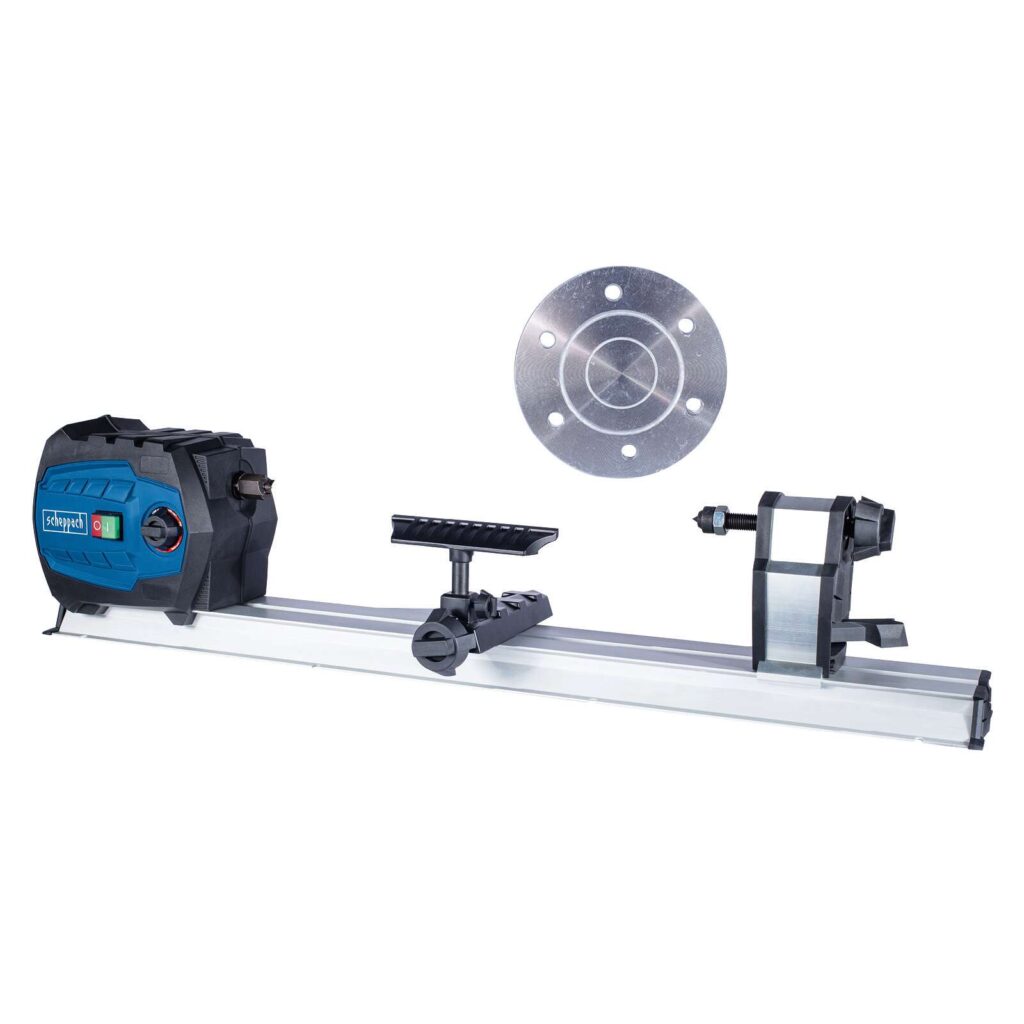
600 mm between centers, 250 mm swing over the bed and a 550 W motor with electronic speed control from 800 to 3,000 rpm. Scheppach includes a faceplate, drive center, live center and mounting screws. If you want to turn tool handles, pens or short spindles, this gives you a handy entry-level machine. For heavy blanks, it lacks the slow pace.
Scheppach DM1100T: a lot of length on a light bed
With a meter between centers and 350 mm swing over the bed, the DM1100T has the largest dimensions on this list on paper. The 400 W motor drives through four belt steps. Two turning chisels, one straight and one hollow, are included. We see it where long spindles such as chair legs are on the agenda and the workshop has no room for 50 kg of cast iron.
Holzmann D460FXL: cast iron for getting started
According to Holzmann, the bed, headstock, tailstock and tool rest are made of cast iron, and the machine weighs 35 kg. With a center height of 153 mm, platters of a good 30 cm fit over the bed, and the M33 thread opens the way to common chucks. Two tool rests of 150 and 300 mm are included, and a bed extension brings the distance between centers to 920 mm. The weak point is the minimum speed of 650 rpm. With large bowls, it limits your room to maneuver.
Holzmann D510F: our recommendation for bowls and boxes
The D510F combines what makes the difference when starting out. It starts at 250 rpm and has 735 W continuous output, forward and reverse, a digital display and a spindle that can be locked every 15 degrees. 55 kg of cast iron keep even an out-of-round blank steady. Holzmann offers a 644 mm bed extension. If you only turn spindles, you will not make full use of this equipment.
Record Power DML320: the English alternative
On the data sheet, the DML320 is close to the D510F: 510 mm between centers, 320 mm over the bed, 250 to 3,850 rpm, M33 and MT2. Record Power states 550 W output, reverse and an indexing system with 24 positions for decorations at equal intervals. A tool tray sits on the headstock. Which of the two machines you choose will ultimately be decided by accessories and service, not the technology.
Turning tools: better three sharp ones than a dozen dull ones
Large sets fill the case. At the start, only a few shapes are needed: a roughing gouge that makes the square wood round, a skew chisel for smoothing and a parting tool for grooves and cutting off. For bowls, add a bowl gouge. Proxxon’s five-piece set for the DB 250 includes a gouge, flat chisel, pointed tool, roughing tool and finishing tool.
Sharpening is unavoidable. Holzmann’s manual explicitly requires sharp turning tools, and a dull tool tears the fibers instead of cutting them. If you do not want to buy a bench grinder with a jig at first, you can opt for tools with replaceable carbide inserts. Holzmann carries such sets among its accessories. They are not a long-term substitute for sharpening, though, because the inserts wear too.
Dust, gloves, distance: what should be settled before the first shaving
Turning produces fine dust when sanding. The German Technical Rule for Hazardous Substances TRGS 553 treats hardwood dust as carcinogenic and names tumors of the inner nose and paranasal sinuses as a consequence. It is aimed at businesses but also serves as a benchmark for the hobby workshop. There, wood lathes with extraction are among the machines at which the limit value for hardwood dust of 2 mg/m³ is only met with restricted use, for example with short running times. According to the rule, blowing off and dry sweeping are not permitted. Required are industrial vacuums of dust class M or tested dust extractors. For respiratory protection, the TRGS names at least FFP2, and in principle the highest class against carcinogenic dusts. Our guide to dust masks explains the differences.
Gloves stay off. Holzmann prohibits them in the manual because of the rotating parts and requires eye protection, a dust mask and hearing protection. The tool rest should sit 1 to 3 mm in front of the workpiece, just above or below center. Before switching on, turn the wood by hand so that it does not strike anything. Out-of-round blanks can be roughly cut round on the band saw (in German) beforehand. That removes a lot of the imbalance.
How we would decide
- Bowls, boxes and platters up to a good 30 cm: Holzmann D510F or Record Power DML320, both with 250 rpm as the lowest speed.
- Handles, candlesticks and short spindles, maybe more later: Holzmann D460FXL, because of the cast iron and M33 thread.
- Little space and small parts: Scheppach DM600VARIO.
- Chair legs and long spindles without a heavy cast bed: Scheppach DM1100T.
- Model making and miniatures: Proxxon DB 250, unsuitable for anything larger.
Frequently asked questions
What should I look for when buying a wood lathe?
Less at the distance between centers than at a low minimum speed, a heavy bed and a spindle thread that fits common chucks. Typical first projects such as tool handles, boxes or small bowls are short, so around 460 to 510 mm between centers is enough.
Why is the lowest speed so important?
A fresh bowl blank is never round and creates imbalance. Holzmann advises working large and unbalanced workpieces only at low speed until they run evenly round. The D510F and the Record Power DML320 start at 250 rpm, the D460FXL at 650, the Scheppach machines at 800.
What does center height mean on a wood lathe?
It is measured from the bed to the center of the spindle and corresponds to the radius. With a center height of 160 mm, a disc of at most 32 cm in diameter turns over the bed. Some manufacturers only state the center height, others the diameter directly, so double it once.
Which spindle thread makes sense on a wood lathe?
The Holzmann D460FXL, D510F and Record Power DML320 have an M33 thread and Morse taper 2, for which several manufacturers offer chucks, faceplates and drive centers. Scheppach uses M18 with a smaller selection of accessories, and Proxxon makes its own chucks for the DB 250.
Which turning tools do I need at the start?
Only a few: a roughing gouge that makes the square wood round, a skew chisel for smoothing and a parting tool for grooves and cutting off. For bowls, add a bowl gouge. Sharpening is unavoidable, because a dull tool tears the fibers.
How do I protect myself from wood dust when turning?
The German technical rule TRGS 553 treats hardwood dust as carcinogenic. According to it, blowing off and dry sweeping are not permitted; required are industrial vacuums of dust class M or tested dust extractors, and at least FFP2 for respiratory protection. Gloves stay off because of the rotating parts.
Sources
- Proxxon: MICRO wood lathe DB 250
- Scheppach: DM600VARIO wood lathe
- Scheppach: DM1100T wood lathe
- Holzmann: D460FXL_230V wood lathe
- Holzmann: D460FXL operating manual (PDF)
- Holzmann: D510F_230V wood lathe
- Record Power: DML320 Cast Iron Electronic Variable Speed Lathe
- German Committee on Hazardous Substances: TRGS 553 Wood dust, version of 28.2.2025 (PDF, provided by the DGUV, German Social Accident Insurance)
Where to buy
- Holzmann D510F 230VCheck price at Amazon.deCheck price at Amazon.co.ukCheck price at Amazon.nlCheck price at Amazon.com.beCheck price at Amazon.frCheck price at Amazon.itCheck price at Amazon.esCheck price at Amazon.plCheck price at Amazon.seAvailable in Germany: Amazon.de
- Holzmann D460FXL 230VCheck price at Amazon.deCheck price at Amazon.co.ukCheck price at Amazon.nlCheck price at Amazon.com.beCheck price at Amazon.frCheck price at Amazon.itCheck price at Amazon.esCheck price at Amazon.plCheck price at Amazon.seAvailable in Germany: Amazon.de
- Record Power DML320Check price at Amazon.deCheck price at Amazon.co.ukCheck price at Amazon.nlCheck price at Amazon.com.beCheck price at Amazon.frCheck price at Amazon.itCheck price at Amazon.esCheck price at Amazon.plCheck price at Amazon.seAvailable in Germany: Amazon.de
- Scheppach DM600VARIOView at scheppachAvailable in Germany: scheppachCheck price at Amazon.deCheck price at Amazon.co.ukCheck price at Amazon.nlCheck price at Amazon.com.beCheck price at Amazon.frCheck price at Amazon.itCheck price at Amazon.esCheck price at Amazon.plCheck price at Amazon.seAvailable in Germany: Amazon.de
- Scheppach DM1100TView at scheppachAvailable in Germany: scheppachCheck price at Amazon.deCheck price at Amazon.co.ukCheck price at Amazon.nlCheck price at Amazon.com.beCheck price at Amazon.frCheck price at Amazon.itCheck price at Amazon.esCheck price at Amazon.plCheck price at Amazon.seAvailable in Germany: Amazon.de
- Proxxon DB 250Check price at Amazon.deCheck price at Amazon.co.ukCheck price at Amazon.nlCheck price at Amazon.com.beCheck price at Amazon.frCheck price at Amazon.itCheck price at Amazon.esCheck price at Amazon.plCheck price at Amazon.seAvailable in Germany: Amazon.de